
 Scan on WeChat
Watch Three Lines First
Start here, then browse the full 24 below.
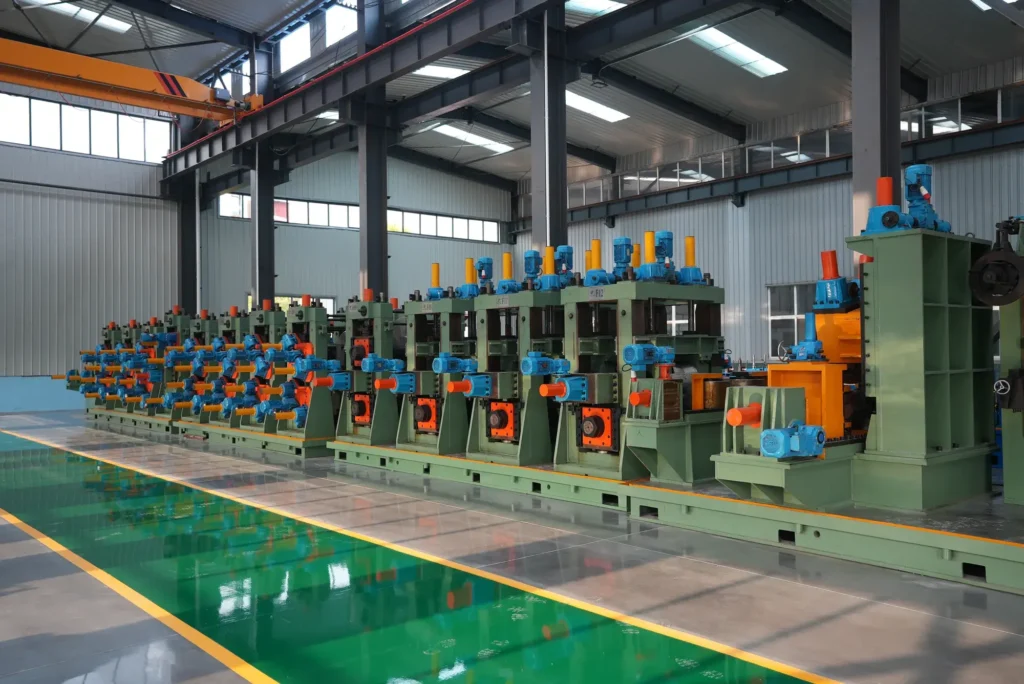
The video library is organised in three parts: how a line runs, how to choose size and power band, and what inspection looks like.
What Is in the Library
The library is split three ways because the three questions are asked at different stages: 1. Buying a production line from photographs is difficult, and buying one from a specification sheet alone is worse. Video is the only medium that shows a mill doing the thing the specification claims — strip entering, seam closing, pipe leaving at length — which is why we keep a video library rather than a few clips.
Footage of a line being assembled, run and cut to length in a works that also machines its own forming rolls is difficult to borrow from someone else, which is why the same buyers who ask for a video tour of the plant also ask for run footage of the specific line class they are being quoted for.
Process — how a line actually runs, end to end. Asked early, usually by someone who has not operated this equipment class before. 2. Selection — how to choose a diameter class and a power band. Asked once a target product is decided. 3.
Inspection — what testing and acceptance look like. Asked late, usually by a buyer who has a standard to satisfy.
For an overseas buyer the library does something a brochure cannot: it separates a manufacturer from a trading intermediary.
Process Videos — How the Line Runs
On a high-frequency longitudinal line the sequence is eight stages, and each one is visible on video in a way it is not on paper: 1. Uncoiling — a coil car loads the coil onto an expanding-mandrel uncoiler, which tensions it pneumatically. Poor centring or tension shows up much later as a wandering strip. 2.
Head straightening and levelling — a five-roller leveler flattens the strip. Strip flatness is the precondition for forming quality; residual curvature becomes a forming ridge or a weld offset downstream. 3. Shear and strip welding — an automatic shear-welder cuts off the irregular head and tail and joins one coil to the next, so the mill does not stop between coils. 4.
Spiral accumulator — strip is stored between the shear-welder and the mill, feeding the mill while the next coil is prepared. This is the buffer that makes continuous production possible at all. 5. Roll forming — forming rolls progressively bring the flat strip to the required round or square section. This stage decides tube shape and seam alignment together. 6.
High-frequency induction welding — the HF current concentrates at the seam through skin and proximity effect, heats it to welding temperature, and squeeze rolls close it under pressure. Power, line speed and squeeze have to match; mismatch shows as lack of fusion, cold weld or burn-through. 7.
Sizing and straightening — after cooling, the tube is sized and straightened to final dimension. 8. Cut to length — a flying saw cuts at full line speed. Throughout, a PLC and variable-frequency control layer holds line speed and cut length repeatable.
The seam is welded inside and out by automatic submerged arc, and the pipe is flying-cut off the line. Forming angle range is 39°–80°; delivery and welding speeds both run 0.5–3 m/min.
Two things are worth watching for rather than reading about. The first is size change: on direct-square-forming lines, size is changed by combined dies instead of by changing rolls, and roll consumption falls by more than 90% — a claim that is far more convincing on video than in a table. One exception: making 100 × 100 mm tube needs the upper roll on the final open stand changed.
The second is the control layer: PLC industrial computer with variable-frequency and servo control, with the automation level selectable from semi- to fully automatic.
A spiral submerged-arc line looks entirely different on video, and the contrast is instructive. Coil is uncoiled on a double-cone head, pinch-levelled, shear-and-butt-welded, optionally edge-milled, then delivered through guide plates and pre-bent before a three-roll bending unit winds it helically at a set forming angle.
Selection Videos — Choosing Size and Power Band
High-frequency longitudinal mills cover Φ10–630 mm across twelve model steps, HG32 through HG630; spiral submerged-arc mills cover Φ219–1620 mm in two machine classes. Selection starts with one number — the largest outside diameter the plant intends to sell — and that number decides the welding technology before it decides anything else.
On power band, the honest position is the one taken across this whole site: welder power is matched to diameter in steps across the range 150–1500 kW. (HG50 / HG76 / HG89 / HG114 / HG165 / HG219 / HG273 / HG325 / HG426 / HG508) is quoted per project. The two endpoints: HG32 = 150 kW and HG630 = 1500 kW.
Overlap matters too. Between Φ219 mm and Φ630 mm both technologies can make the pipe, and the right answer depends on batch size, wall thickness and the standard the finished pipe must
Ask an Engineer — Reply Within a Single Contact →
Line Videos — 24 Production Lines on Our Channel
 HG32 HFW Pipe Mill — O.D. 10–32 mm
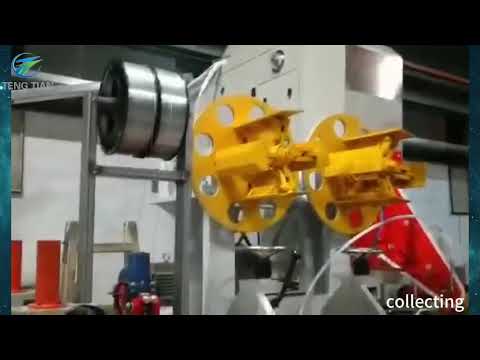 HG50 HFW Pipe Mill — O.D. 16–50.8 mm
 HG76 HFW Pipe Mill — O.D. 12.7–76 mm
 HG89 HFW Pipe Mill — O.D. 32–89 mm
 HG114 HFW Pipe Mill — O.D. 45–114 mm
 HG165 HFW Pipe Mill — O.D. 60–165 mm
 HG219 HFW Pipe Mill — O.D. 114–219 mm
 HG273 HFW Pipe Mill — O.D. 114–273 mm
 HG325 HFW Pipe Mill — O.D. 165–325 mm
 HG426 HFW Pipe Mill — O.D. 165–426 mm
 HG508 HFW Pipe Mill — O.D. 219–508 mm
 HG630 HFW Pipe Mill — O.D. 325–630 mm
 SSAW Spiral Welded Pipe Mill — Φ219–1620 mm
 Automatic Tube Mill 150×150 mm — PLC Full-Auto
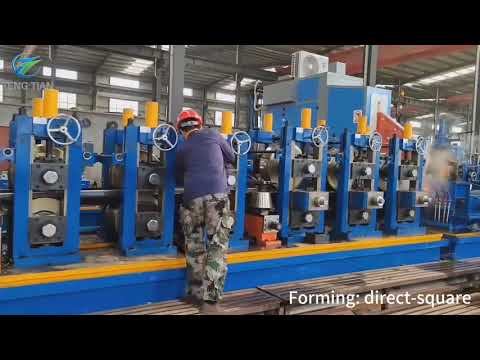 Direct Forming Square Tube Mill 120×120 mm
 Direct Forming Square Tube Mill 150×150 mm
 Direct Forming Square Tube Mill 200×200 mm
 Direct Forming Square Tube Mill 400×400 mm
 Coil Slitting Line — ±0.2 mm Width
 Cut-to-Length Line — Coil to Sheet, up to 32 t
 C/Z/Ω Purlin Roll Forming Machine — 18-Pass
 H-Beam Production Line — GOST R 58966-2020
 Auto Spray Paint Line — up to 60 m/min
 Company Film — Hebei Tengtian
View the full channel on YouTube →
More from the video library
More videos — inspection, process and selection.
Send Your Enquiry
Tell us the pipe outside-diameter range, the wall thickness and the output you need. An engineer reads every enquiry — it does not land in a general sales inbox.