
 Scan on WeChat
Home › SSAW Spiral Welded Pipe Mill › Changing Bore Without Changing Rolls
On a spiral line the pipe diameter is set by the forming angle, not by the rolls.
In This Line
Quick Contact
Hebei TengtianYuanle@tentubemill.com
+86-311-83025332
WhatsApp +852 5425 3155
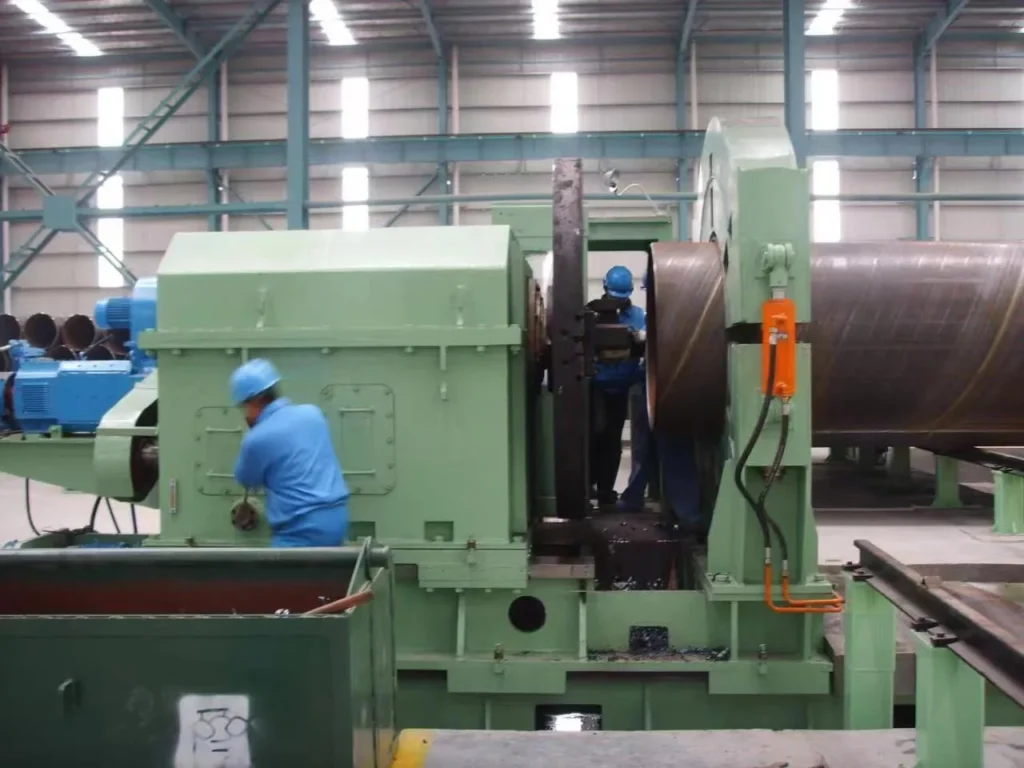
The angle range is 39 to 80 degrees, set by swinging the front bridge, and a diameter change on this line does not require a change of forming rolls.
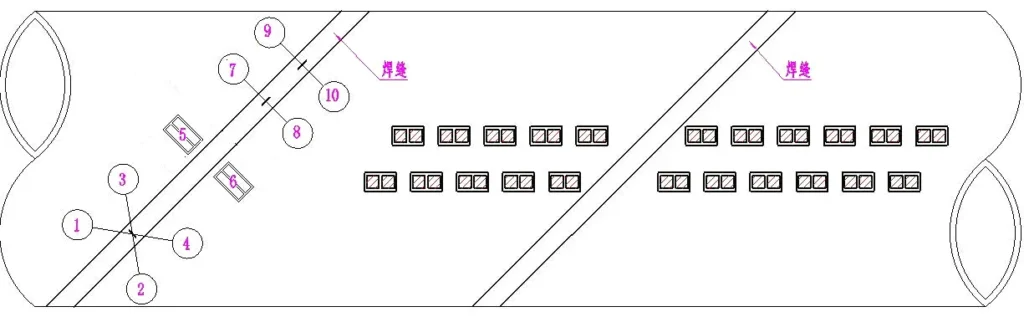
The Numbers That Set a Size on This Line
- Forming angle range: 39° to 80°, set by swinging the front bridge.
- Maximum pitch: 1250 mm on the Φ820 grade, 1900 mm on the Φ1620 grade.
- Incoming strip width: 400–1050 mm or 500–1250 mm, with width tolerance within ±5 mm.
- A diameter change does not require changing the forming rolls.
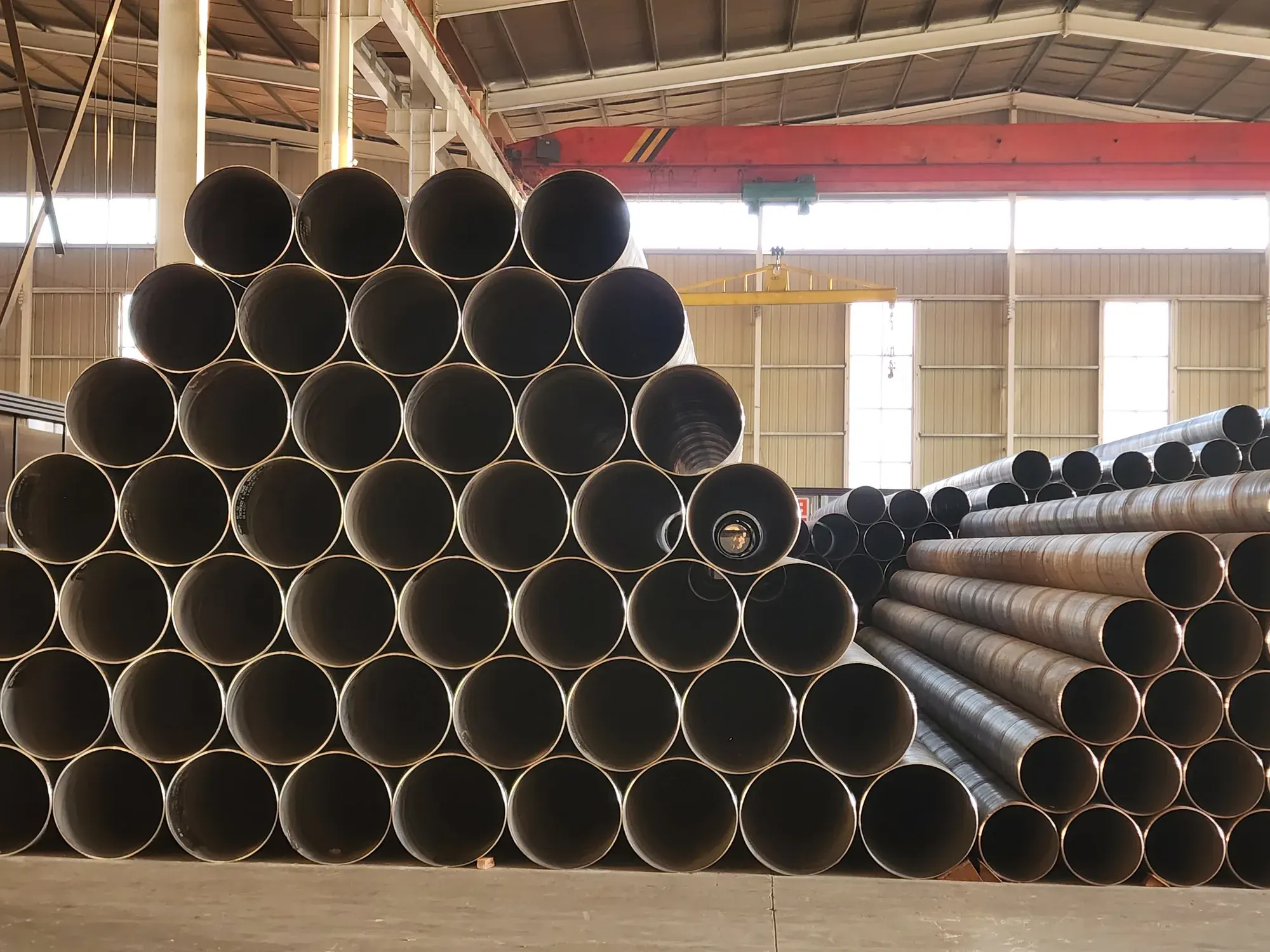
- Pipe envelope: Φ219–1620 mm × 5–16 mm, 8–12 m long, up to 7.5 t per pipe.
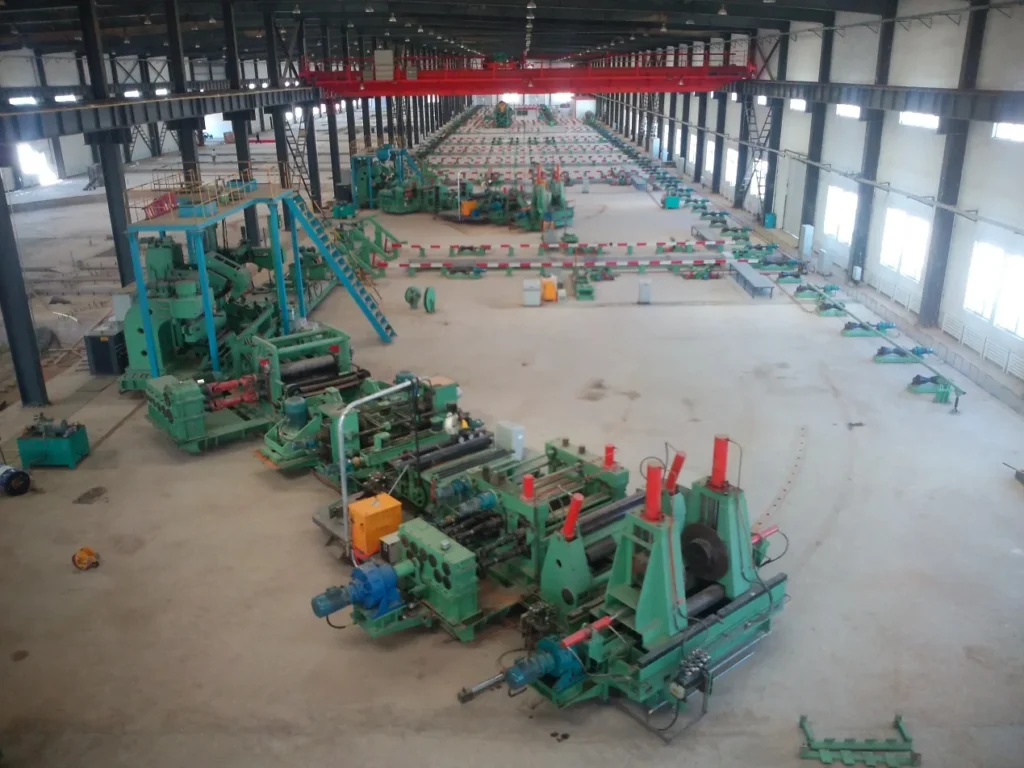
What Is Forming Angle 39°–80°
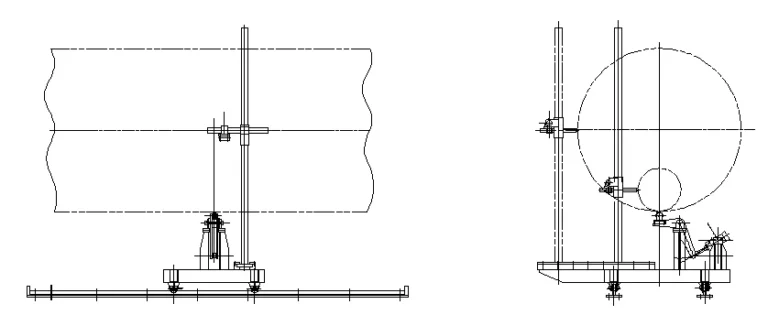
In operation, strip is fed in at a set forming angle between 39 and 80 degrees, is force-bent over three rolls and wound along a helix, and its two edges meet on the blank to form the spiral seam. The forming angle is the angle at which the strip enters the forming machine relative to the axis of the pipe being wound. External sizing then holds the shape.
What that angle controls is a joint relationship rather than a single-variable one. The pipe diameter is determined by the strip width and the forming angle together, and the direction of the relationship is clear: at a given strip width, a smaller forming angle produces a larger pipe diameter.
The parameters governing this principle are the forming angle, the strip width, the roll gap and the pitch.
In practice, a size change on this line is a setting change, not a tooling change. On a straight-seam mill the target diameter is set by the roll set. On this line it is set by an angle, which means a diameter change needs no change of forming rolls.
The commercial consequence of that is the reason the line exists at all. Tengtian’s high-frequency straight-seam range is bounded at Φ630 mm, so a buyer wanting larger line pipe, water and drainage pipe or structural pipe has to move to spiral submerged-arc welding.
As a result, because one spiral machine group covers Φ219 to Φ1620 mm by adjusting the forming angle, the buyer does not have to build a separate line for each diameter band.
The same point shows up when the spiral route is compared with the alternatives.
The spiral route offers wide single-machine diameter coverage and the ability to make large-diameter, heavy-wall pipe up to Φ1620 × 16 mm at 7.5 tonnes per pipe, at the cost of a slower welding speed of 0.5 to 3 metres per minute and discontinuous rather than continuous production.
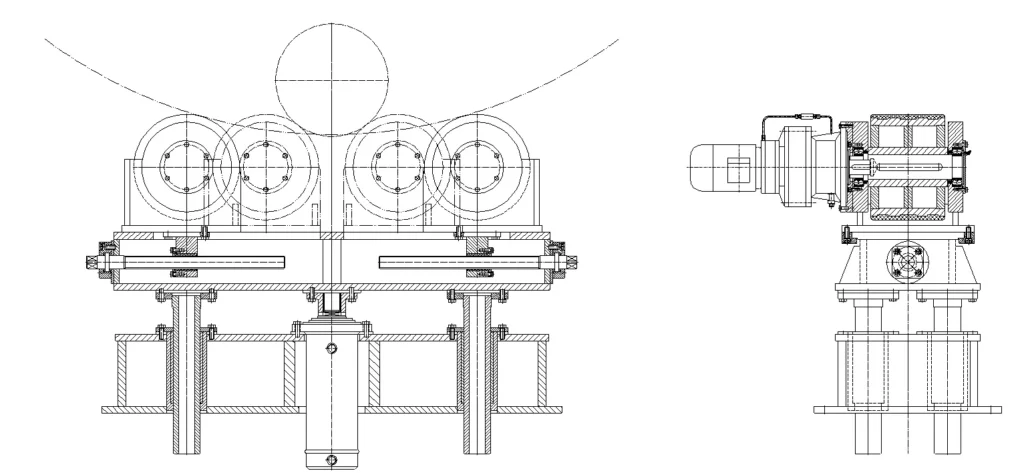
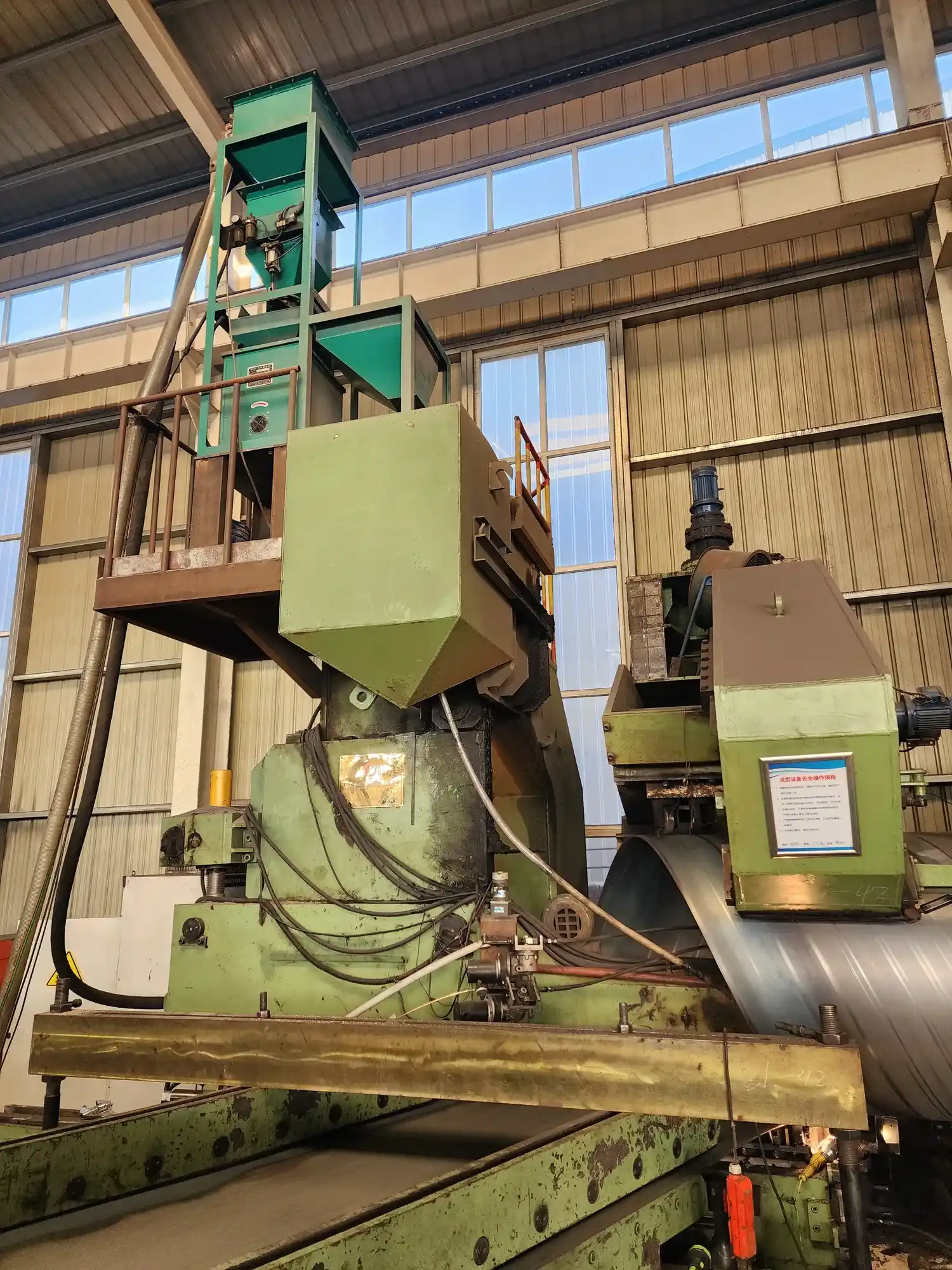
Three roll bending spiral pipe mill
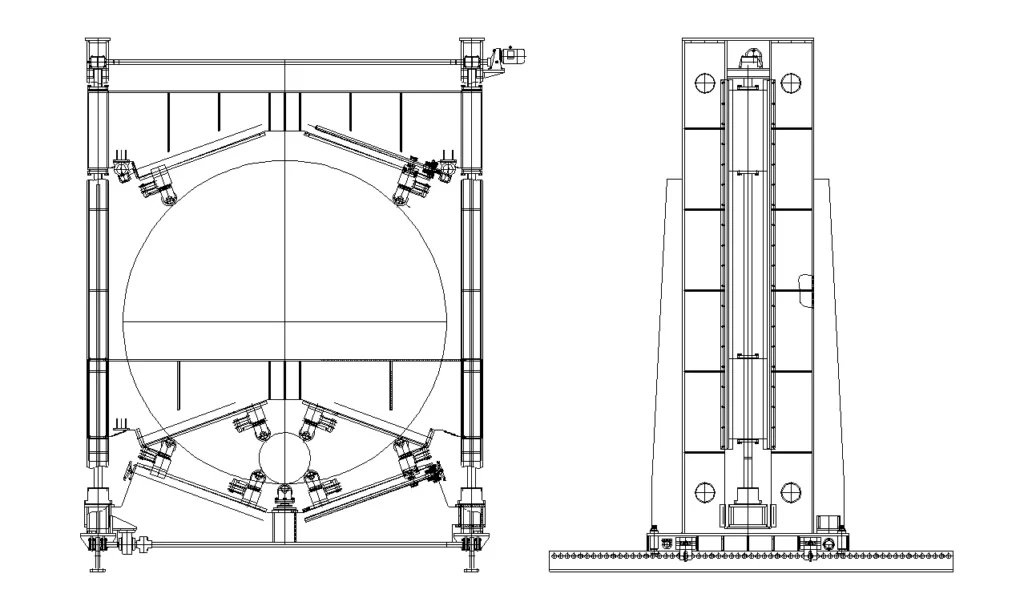
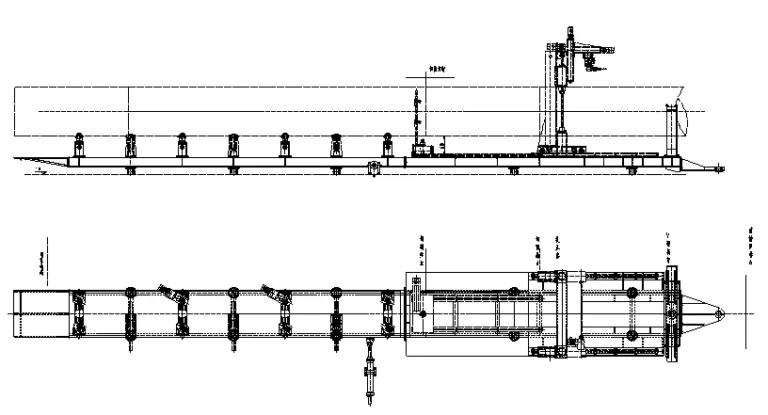
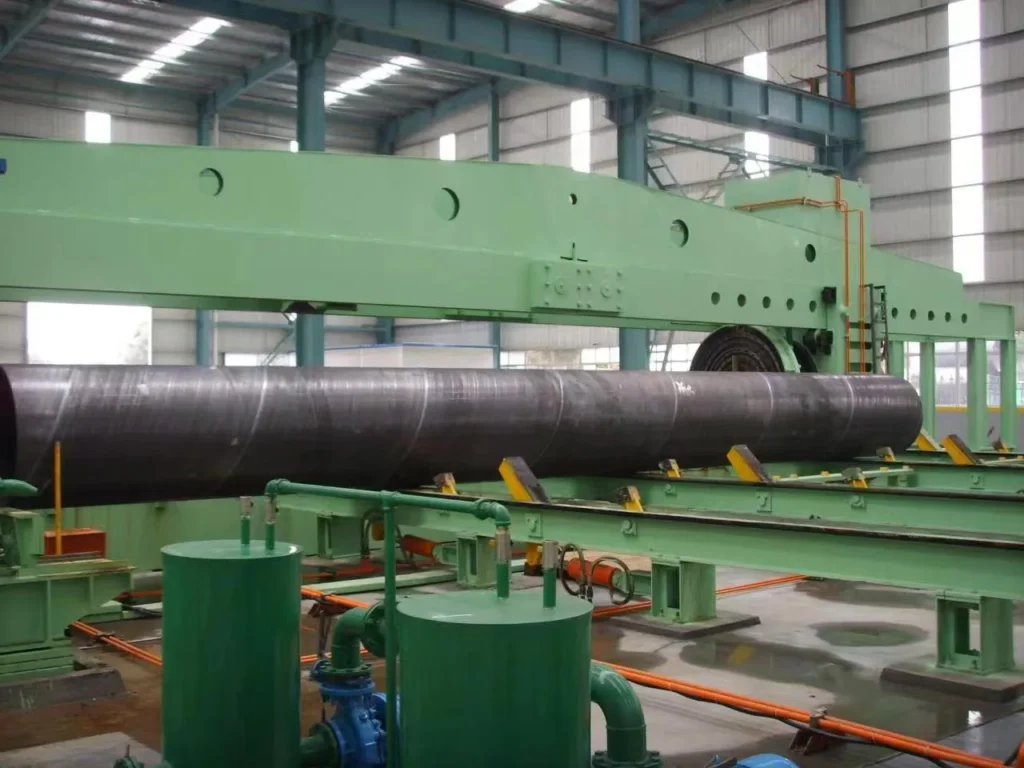
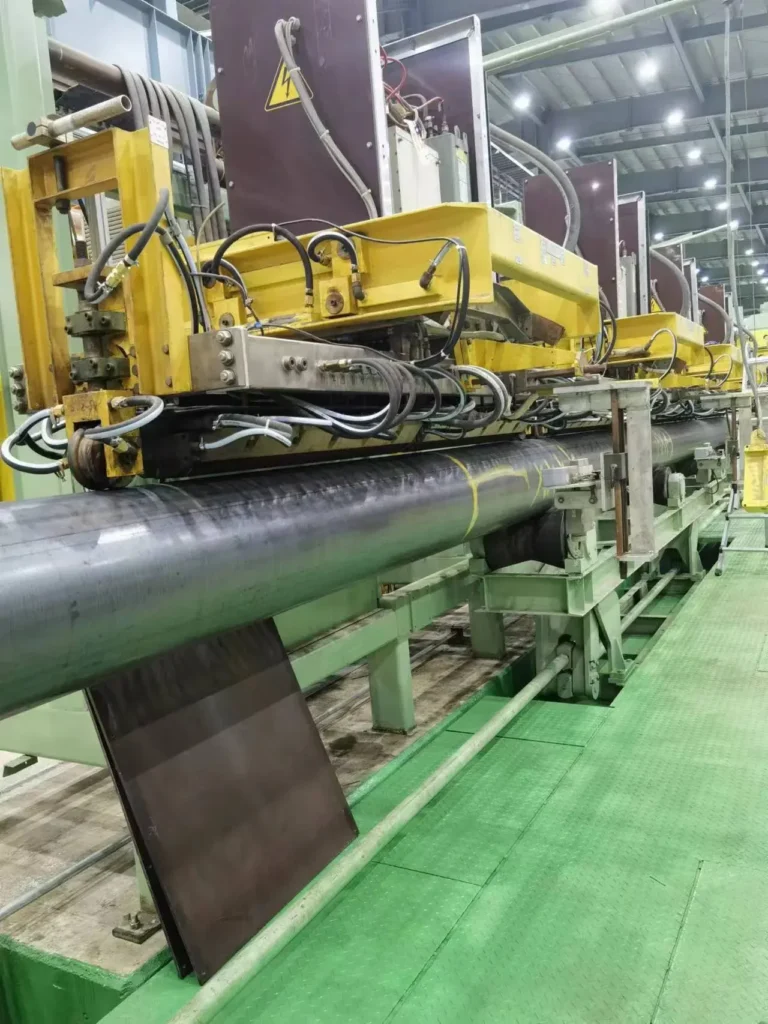
The forming machine bends the strip over three rolls with external sizing to produce the spiral blank. A front bridge carries the equipment ahead of forming and swings to set the forming angle; a rear bridge carries the equipment after forming, allows fine angle adjustment, and discharges the pipe.
The build includes a twin base with an inclination, Φ130 GCr15 backing rolls hardened to HRC 56–60, and a front-bridge swing cylinder of Φ150 / Φ85 × 450.
If forming accuracy or the swing angle is off, pipe diameter, pitch and ovality are all affected at once. Strip enters through 1# to 7# rolls in the forming sequence.
Against high-frequency straight-seam welding, the spiral route substitutes a spiral seam and submerged-arc welding for a straight seam and high-frequency welding, and changes diameter by changing the angle rather than the rolls.
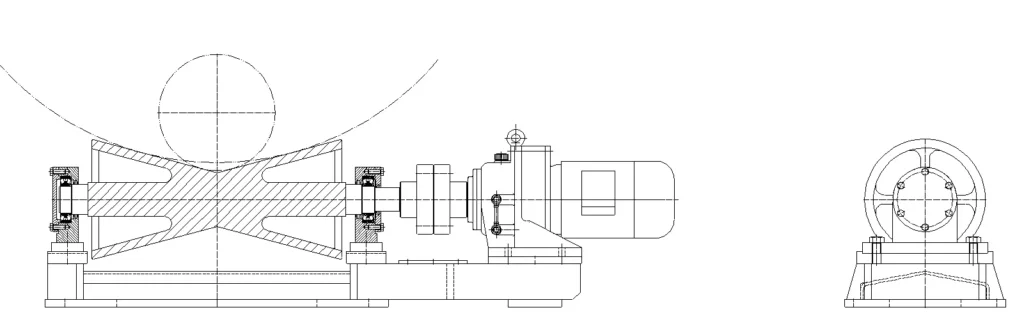
Forming Angle 39°–80° — Method and Measured Values
The angle range is 39 to 80 degrees. Four measured values bound the size-change operation. Maximum pitch is per line grade: 1250 mm on the Φ820 grade and 1900 mm on the Φ1620 grade.
Incoming strip width is 400 to 1050 mm or 500 to 1250 mm depending on grade, with a stated incoming requirement that width tolerance stays within ±5 mm. And the resulting pipe envelope is Φ219 to Φ1620 mm at 5 to 16 mm wall.
Treat the width tolerance as an operating constraint, not just a purchasing note. If strip width fluctuates, the forming angle has to be corrected repeatedly, the diameter drifts, and the edges do not meet cleanly at the seam. On a line where the angle is the size control, incoming width variation is a direct source of size variation.
Two further mechanisms hold the shape once the angle is set. Guide plates with 42CrMo pre-bending rolls hardened to HRC 52–58 curve the strip edges before they enter the forming machine; the reason is that insufficient pre-bend or worn guide plates leave a straight edge on the blank, which shows up as out-of-tolerance ovality and misalignment at the seam.
And the delivery machine — a planetary reducer driving Φ360 forged 42CrMo rolls through 2 × 15 kW variable-frequency motors at 0.5 to 3 metres per minute — is the line’s main drive; the consequence of delivery speed fluctuating is pitch drift and unstable seam tracking.
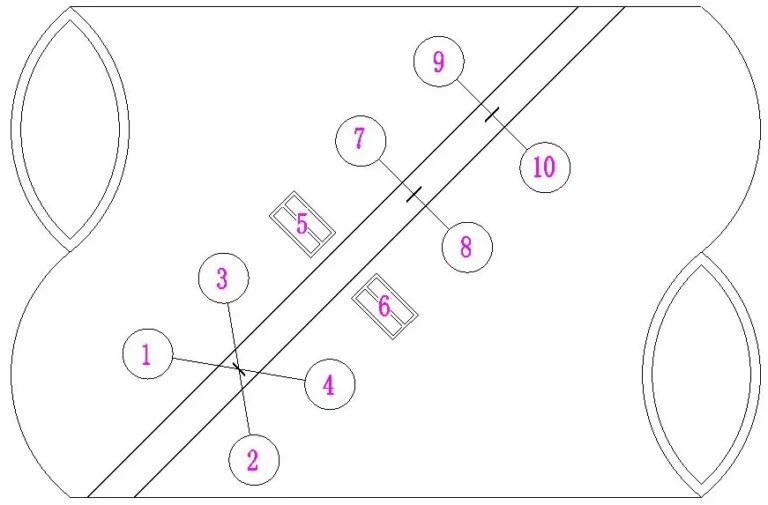
Standards Behind the Forming-Angle Figures
For the Φ1620 grade, API 5L also applies. The standards that apply to the spiral line are product-level for the finished pipe rather than for the forming operation. Both line grades are built to GB/T 9711.
Separately, the enterprise standard Q/GYLTT01-2023 covering HGF150 high-frequency welded pipe equipment was issued on 31 August 2023 and took effect on 15 September 2023, published on the national enterprise-standard platform as a twelve-page document.
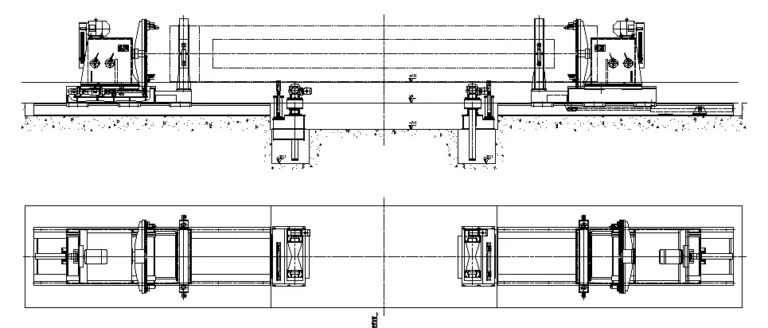
Step-by-Step Procedure
Loading and threading the coil works as follows: the crane lifts the coil to the uncoiler centre, the twin cone heads align and clamp hydraulically and centre the coil to the machine axis, a swing knife head presses the strip down, and the main drive then leads the strip head into the pinch-and-levelling unit.
Setting a new outside diameter means adjusting the front-bridge swing angle, with fine adjustment on the rear bridge, to set the forming angle; determining the pitch together with the strip width; and re-checking the machine’s centre positioning. Changing diameter does not require changing the forming roll set.
Three checks are required after the change, and skipping them has specific consequences. The checks are the swing-angle setting, the centre-positioning re-check, and measurement of the actual diameter and pitch on the first pipe. The failure modes are diameter deviation after the change, pitch drift, seam misalignment and scrap pipe during commissioning.
The operation requires trained set-up personnel.
Ssaw mill installation and commissioning
Two operating steps sit either side of the size change, and each has its own training requirement.
Joining coils is shearing the head and tail square with the hydraulic shear, submerged-arc butt welding them on a travelling welding carriage, and re-centring with powered or manual vertical rolls before feeding resumes.
Setting the welding parameters is the step needing specialist process training. Flux is loaded and dried and the wire spool fitted; inner and outer welding current, voltage and speed are set at 0.5 to 3 metres per minute and synchronised to the delivery speed; then continuous forming and welding runs with the seam formation, flux coverage and flux recovery watched throughout.
The size-change operation is one of the five operating steps of the line, and it has its own training requirement.
Worked Example — The Forming-Angle Envelope
The envelope is defined by these limits: the angle runs from 39 to 80 degrees, the pitch is capped at 1250 mm on one grade and 1900 mm on the other, incoming strip runs 400 to 1050 mm or 500 to 1250 mm wide within ±5 mm, and the pipe that comes out is Φ219 to Φ1620 mm at 5 to 16 mm wall, 8 to 12 metres long, up to 7.5 tonnes.
The relationship above gives the direction only; there is no fixed table of forming angle against diameter or strip width, and no worked calculation. For your sizes, the actual diameter and pitch are measured on the first pipe after set-up. Wall thickness, line speed and shift output are confirmed against your pipe size, material grade and cut length at quotation. Send us those three and we will state the figures.
The capacity figures a buyer usually asks about next apply to the line as a whole, not to any single angle setting. Installed main-machine power is 200 kW on the Φ820 grade, with an actual draw of 160 kW, and 300 kW on the Φ1620 grade.
Delivery speed is 0.5 on the Φ820 grade or 0.6 on the Φ1620 grade up to 3 metres per minute, and welding speed is 0.5 to 3 metres per minute.
What feeds the forming machine
Three stages sit upstream of the forming angle and each one can move the result. Uncoiling runs on a twin-cone-head uncoiler that lifts, aligns and clamps hydraulically and centres the coil to the machine axis. Pinch-and-levelling follows.
On the Φ1620 grade an edge milling machine prepares the strip edges into a bevel, with a Φ500 cutter head, a maximum cutter speed of 190 metres per minute and a milling width of 500 to 1250 mm; on the Φ820 grade the equivalent stage is disc shearing of the edges.
That matters for size changes because the edge preparation and the pre-bend together decide whether the two strip edges meet cleanly once the angle has been reset. The failure chain runs from insufficient pre-bend or worn guide plates, through a straight edge on the blank, to out-of-tolerance ovality and misalignment at the seam.
What to ask the factory for
Three questions turn a general enquiry into a specification. Ask for the forming angle and pitch actually used for the two or three diameters you intend to run, measured on the first pipe rather than taken from a design chart — first-pipe measurement is part of the size-change procedure.
Ask which incoming strip widths the quotation assumes, because the width is half of what sets the diameter and the ±5 mm tolerance is a stated incoming requirement. And ask how long a size change takes on the shop floor with your own crew.
Resource Downloads
From the Workshop
 SSAW or HFW
 What the Large-Diameter Tier Adds
 X-Ray, Hydrostatic and Ultrasonic, Station by Station
 The API Pipe Mill Inspection Chain
Send Your Enquiry
Tell us the pipe outside-diameter range, the wall thickness and the output you need. An engineer reads every enquiry — it does not land in a general sales inbox.