
 Scan on WeChat
Home › Tube Mill › Large-Diameter Tube Mill › HG426
The tenth of the twelve model steps — Φ165 – Φ426 mm round pipe and 130×130 – 330×330 mm square section, on a 800 kW high-frequency welder.
Model Steps
In This Line
Quick Contact
Hebei TengtianYuanle@tentubemill.com
+86-311-83025332
WhatsApp +852 5425 3155
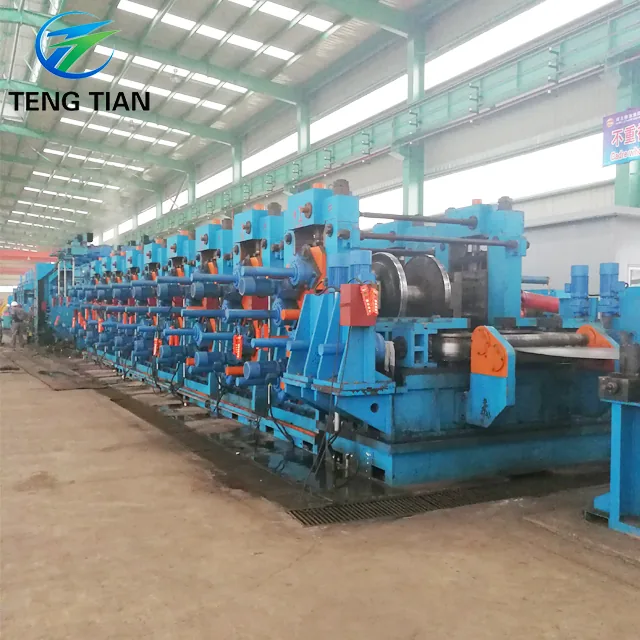
HG426 is the high-frequency model step covering Φ165 to 426 mm — the only step that reaches 426 mm while still starting as low as 165 mm. It runs round, square and rectangular section, and it is sized against your pipe rather than sold fixed.
Line Specification — HG426×12.7
| Round tube outside diameter | Φ165 – Φ426 mm |
|---|---|
| Wall thickness | 4.0 – 10.0 mm |
| High-frequency welder | 800 kW |
| Square / rectangular tube | Square 130×130 – 330×330 mm; wall 4.0 – 9.5 mm |
Watch This Line Running
HG426 High-Frequency Welded Pipe Mill — O.D. 165-426 mm
Technical Specification Table
Model step: HG426 Outside diameter: Φ165–426 mm Section shapes: round, square, rectangular Welding process: high-frequency induction welding Forming technology: conventional roll forming, or direct forming square Automation grade: semi-automatic, or full-automatic under PLC control Series wall range: 0.5–16 mm across HG32–HG630 Series welder power:
150–1500 kW, stepped with diameter Material yield: 93% or better by line design
There is a second 426 in our product range, and confusing the two would send a buyer to the wrong line. API 426 is a model step of our API line-pipe mill, whose steps are API 219, 406, 426 and 508 across OD 114–508 mm with wall 6–24 mm by step.
That line adds medium-frequency annealing, straightening, end facing, hydrostatic testing, ultrasonic and eddy-current inspection on top of a welded line, so that the pipe produced meets API 5L. The core increment over a general welded pipe line is post-weld heat treatment plus a full non-destructive inspection chain — not a larger welder.
Those API figures belong to the API line, not to the HG426 specification.
Line Configuration and Scope of Supply
- Coil car and expanding-mandrel uncoiler, tensioning the coil.
- Five-roller leveller, flattening the strip before forming.
- Automatic shear-welder, joining coil to coil.
- Spiral accumulator, buffering strip so forming continues through the join.
- Forming and sizing mill, the core unit for shape, weld position and dimension.
- High-frequency induction welder, sized to the pipe range.
- Flying saw, cutting to length at speed.
- PLC and variable-frequency control, holding speed and repeat cut length.
The process: rolls form the strip progressively into an open tube; high-frequency current concentrates at the open edges through skin and proximity effect and heats them to welding temperature; squeeze rolls press the edges together to form the seam under pressure; the tube is cooled, sized and straightened.
Φ165 to 426 mm is a span of 261 mm covered by one model step. Two steps span more — HG508 covers 289 mm and HG630 covers 305 mm — but both start higher up, at Φ219 and Φ325 respectively. What is distinctive about HG426 is therefore not the width of the band but where it starts: it is the only step that reaches 426 mm while still coming down to 165 mm.
For a buyer, the consequence is clear. A plant whose product list runs from mid-size structural section up to large-diameter pipe can be served by this one step, where HG508 and HG630 would leave the bottom of that list uncovered.
The trade-off is that the line will be set up across a wide range of settings, and the forming and sizing changes between the bottom and the top of the band are correspondingly larger. Which end of the band the plant will actually run most is therefore a real question at quotation, and it is a different question from asking what the largest pipe on the list happens to be.
Changeover planning is worked out per project.
At the top of this band the strip is wide, and what arrives from the slitting line sets the ceiling on what the forming mill can achieve. Our slitting and cut-to-length line handles strip 1–12 mm thick and 800–2000 mm wide in coils up to 32 t, holding slit width to ±0.2 mm, camber to 0.5 mm per 1000 mm, burr to 4% of material thickness and telescoping on the recoil to ±10 mm.
Camber is the one that cannot be recovered downstream: a leveller flattens the strip in the thickness direction, but a strip that curves along its length will not present its edges to the squeeze rolls consistently, and the seam wanders with it.
The line is the standard eight-unit high-frequency train, sized to this diameter step.
Size Change, Roll Wear and Running Cost
A direct-forming square build adjusts a combined die set by servo, with a roll saving above 90% because contact is point contact rather than full-face. Because this step spans a wide band, size change matters more here than on a narrow step. One exception: making 100 × 100 mm tube needs the upper roll on the final open stand changed.
Rolls are machined in-house on our own CNC equipment, so replacement rolls remain obtainable years after handover.
The forming technology chosen with the line changes the economics of that directly. A conventional build changes size by changing rolls.
Servo setup and direct forming also reduce drift after a size change, which is what batch consistency across a wide band depends on. Operator practice is the third variable: a trained change crew keeps scrap during a size change down.
Consumables and wear parts follow the series list — saw blades and cutting tools; impeders and induction coils; cooling water, emulsion, hydraulic oil and grease; and forming and sizing rolls as replacement items.
Ten factors decide whether the line holds quality across a production run, and they apply at this step as at any other: incoming strip grade, thickness tolerance and flatness; roll material and heat treatment; welding power, frequency and speed; squeeze amount and seam alignment; sizing and straightening; impeder and induction-coil condition;
control and servo stability; operator setup and changeover practice; final inspection; and post-weld cooling matched to welding speed.
On a step with this span, the eighth of those — setup and changeover practice — carries more weight than it does on a narrow step, simply because it is exercised more often.
Impeder and coil condition deserves one specific note at this diameter. Their job is to keep the high-frequency current concentrated at the seam; as they degrade the energy spreads, seam quality fluctuates and consumption rises before anything visibly fails.
Forming and sizing rolls determine shape accuracy, roundness and squareness, edge definition and dimensional consistency, and roll material and heat treatment decide how long that holds. Where they are wrong, the symptoms are early wear, diameter drift, uneven corner lines and repeated re-machining at every change.
Applications and Output Examples
At Φ165–426 mm both application families apply.
Fluid transport pipe — carbon-steel welded pipe for oil and gas transport, municipal water and drainage, gas distribution, and chemical and heating pipework, measured on weld pass rate, diameter and wall coverage, non-stop coil change, and energy and yield per tonne.
As on every line in the series, responsibility divides as follows: the mill controls welding power, seam alignment and squeeze; sizing and straightening set dimensional accuracy and straightness; line design supports material yield above 93%. Incoming strip grade, thickness tolerance and flatness, and operation, remain the buyer’s side.
Two purchase triggers apply particularly at this end of the range. Entering a new product type needs a dedicated line rather than an adaptation of an existing one — and a plant moving up from small-diameter production into Φ300–426 mm work is doing exactly that. And a large downstream order pushes buyers to add capacity fast enough to deliver on schedule.
Two switching triggers apply as well: poor after-sales and spare-part supply from an incumbent, and entering a standard-governed market such as API 5L or GOST, which requires compliant equipment rather than an upgrade of what is already installed.
Structural and scaffolding tube — square, rectangular and round sections for load-bearing steelwork, scaffolding and general machinery components, measured on corner definition and straightness, changeover efficiency and electricity per unit.
Delivery, Installation and Training
Lead time is 50–90 days.
Five operating steps need different levels of training: coil loading and threading, and shear-welding a coil join in time with the accumulator, need operator training; setting a new size needs a trained change crew — and on a step with this span that crew will be used often;
setting welder power, welding speed and squeeze and then running the process needs process-level training; cutting and collecting is routine.
After handover, support is a first reply through a single named point of contact, all-hours online support, on-site dispatch when required, and direct spare-part shipment. Behind that sits in-house CNC roll machining, an engineering team of twenty averaging twenty years each, and an owned production base open to factory audit.
Certifications: GB/T 19001-2016 / ISO 9001:2015 (quality management system, certificate No. 18524Q11269R2S); CE for welded pipe equipment, UDEM No. M.2022.206.C72171. For pipe made to API 5L, see our separate API line-pipe configuration.
Export packing is specified per item. Control cabinets, impeders and induction coils, forming rolls and cutting tools travel in moisture-protected wooden cases with a spare-parts pack; heavy frames at this diameter ship bare, braced on cradles with designated lifting points and rust protection.
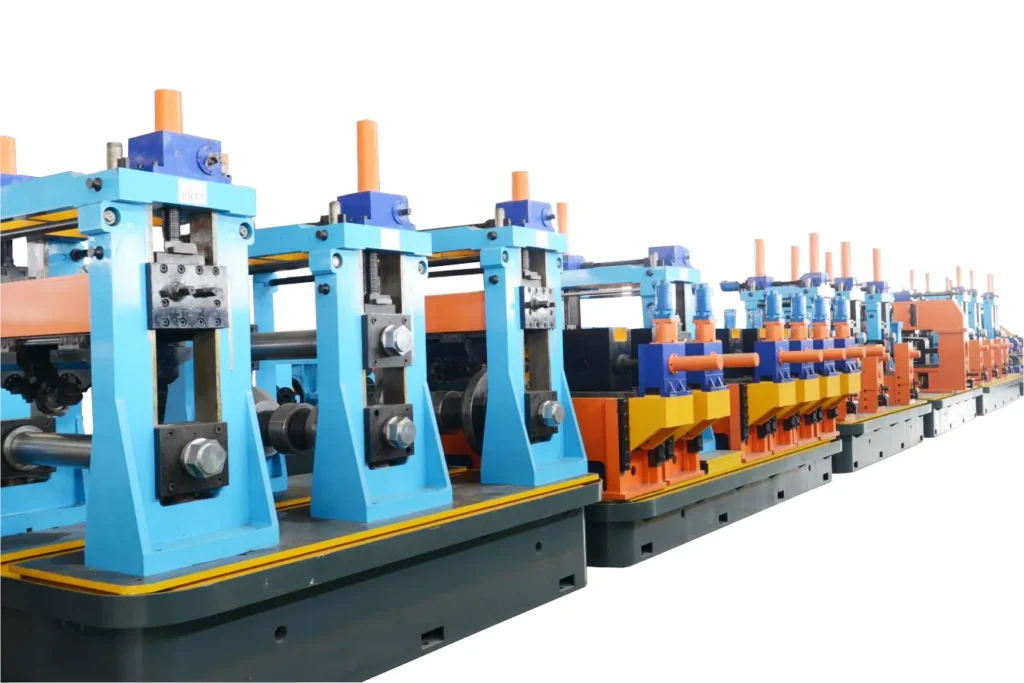
Large diameter tube mill for 426mm pipe
Tube mill for 426mm pipe
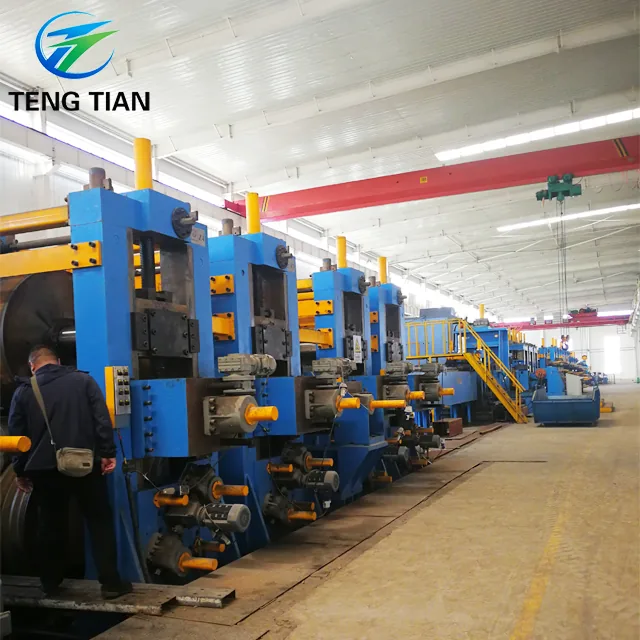
Line Photos from the Works
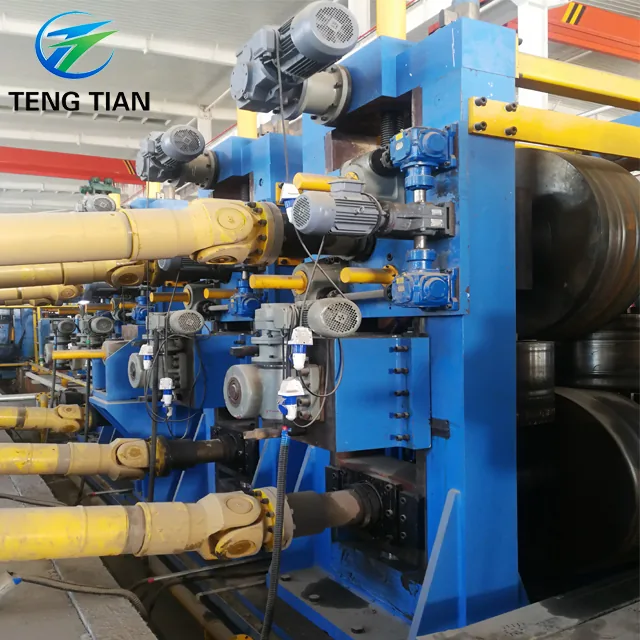
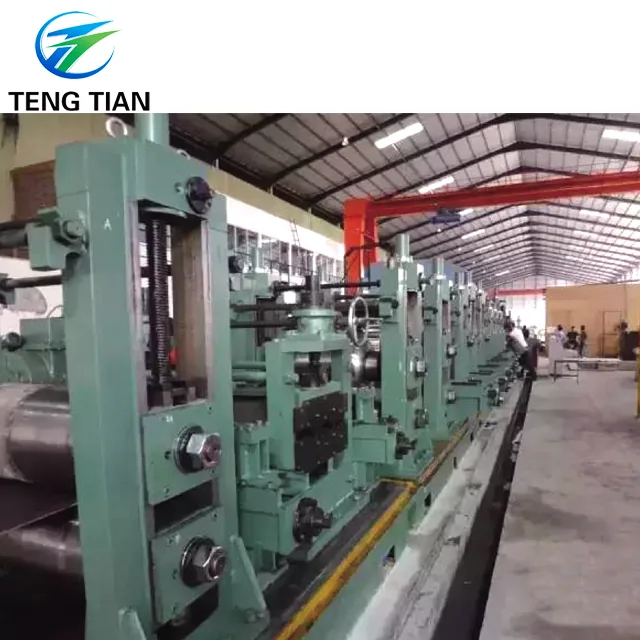
Two photographs of this line, taken in our own workshop. Click any photo for the full-size image.
More from this line
 HG273
HG273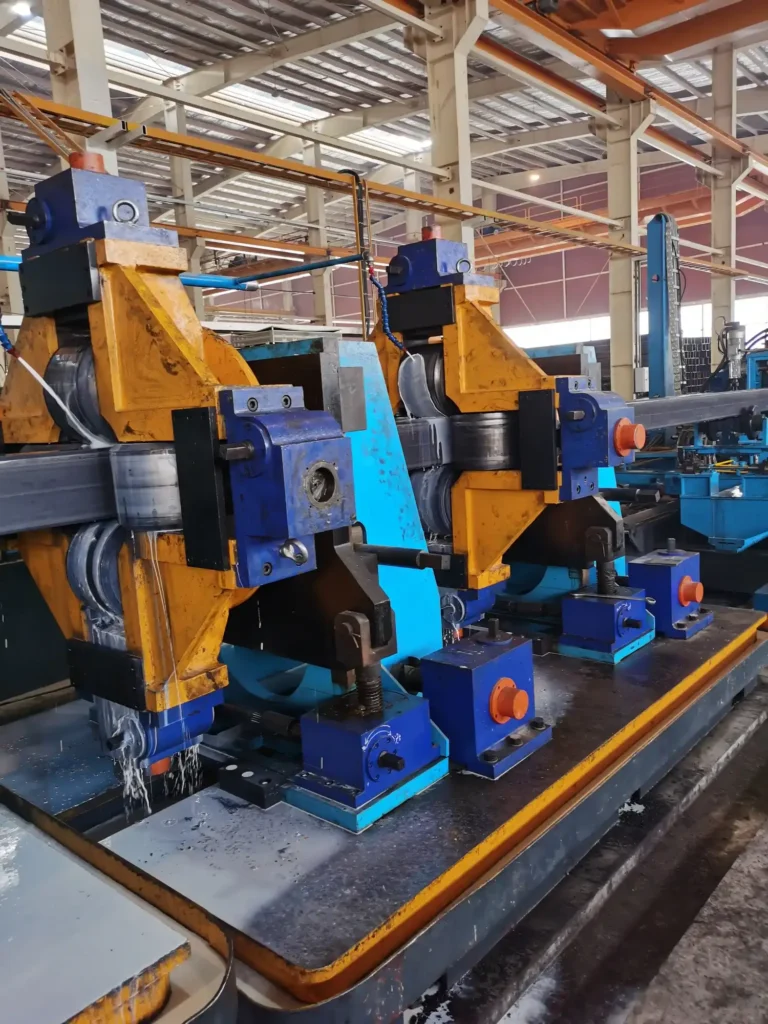 HG325
HG325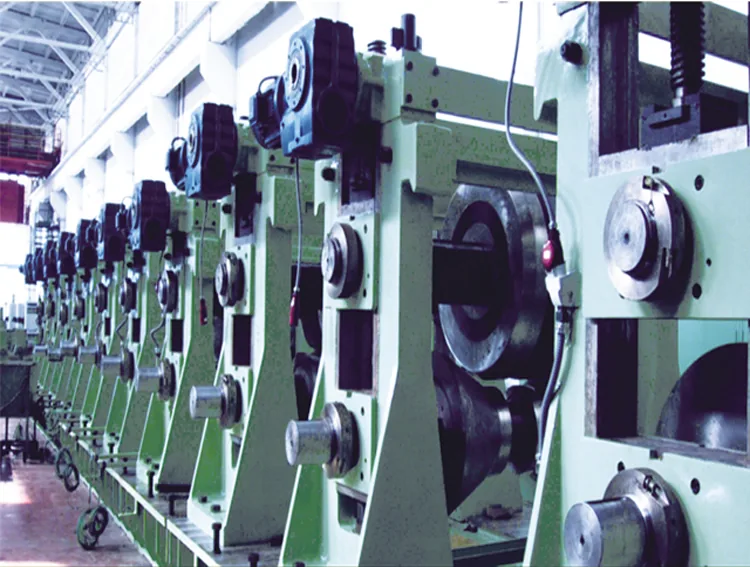 HG508
HG508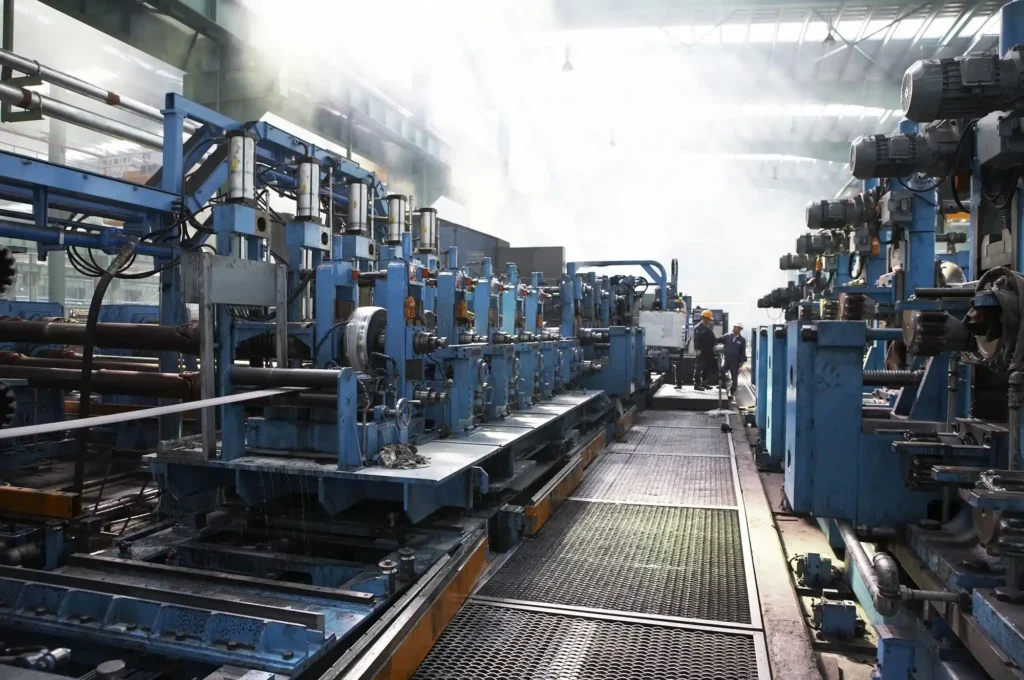 HG630
HG630Send Your Enquiry
Tell us the pipe outside-diameter range, the wall thickness and the output you need. An engineer reads every enquiry — it does not land in a general sales inbox.