
 Scan on WeChat
Home › Tube Mill › Small-Diameter Tube Mill › HG114
The fifth of the twelve model steps — Φ45 – Φ114 mm round pipe and 35×35 – 90×90 mm square section, on a 300 kW high-frequency welder.
Model Steps
In This Line
Quick Contact
Hebei TengtianYuanle@tentubemill.com
+86-311-83025332
WhatsApp +852 5425 3155
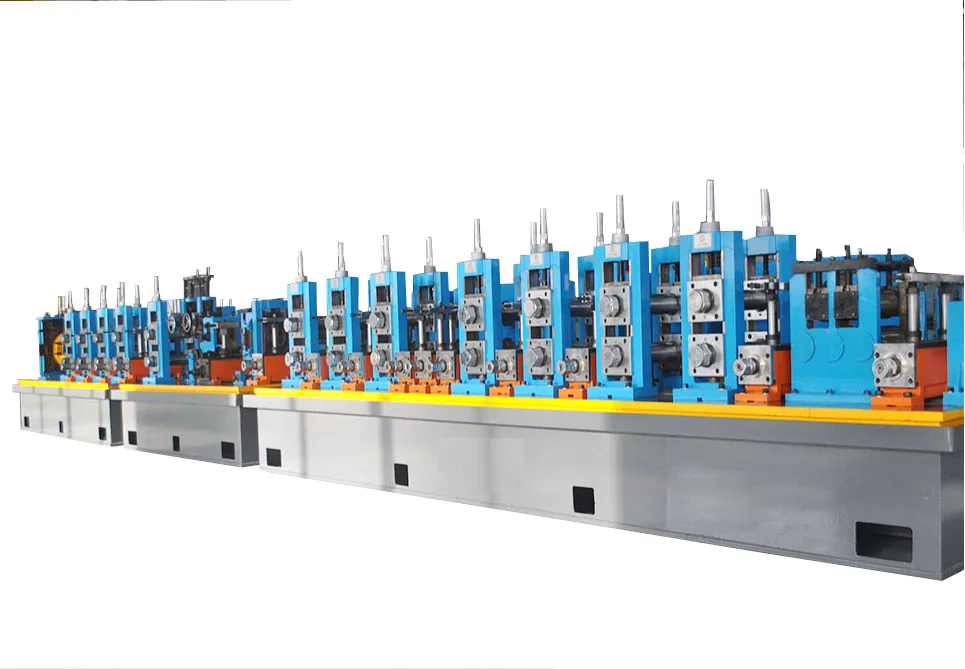
HG114 is the fifth of the twelve steps, covering Φ45–114 mm. It sits at the boundary of the small-diameter group: below it the mills are furniture and fence tube, above it the sections get heavy enough that handling and stacking start to shape the line layout.
Line Specification — HG114×5.0
| Round tube outside diameter | Φ45 – Φ114 mm |
|---|---|
| Wall thickness | 1.5 – 5.0 mm |
| High-frequency welder | 300 kW |
| Square / rectangular tube | Square 35×35 – 90×90 mm; wall 1.5 – 4.5 mm |
Watch This Line Running
HG114 High-Frequency Welded Pipe Mill — O.D. 45-114 mm
Technical Specification Table
- Outside diameter range: Φ45–114 mm, the fifth of twelve steps.
- Section shapes: round, square and rectangular.
- Forming: conventional roll forming.
- Welding: high-frequency induction.
- Automation: semi-automatic or full PLC.
- Welder power for this step: 300 kW
Line Configuration and Scope of Supply
- Expanding-mandrel uncoiler.
- Five-roller leveller.
- Automatic shear-welder.
- Spiral accumulator.
- Forming and sizing mill.
- HF induction welder.
- Flying saw.
- PLC and VFD control.
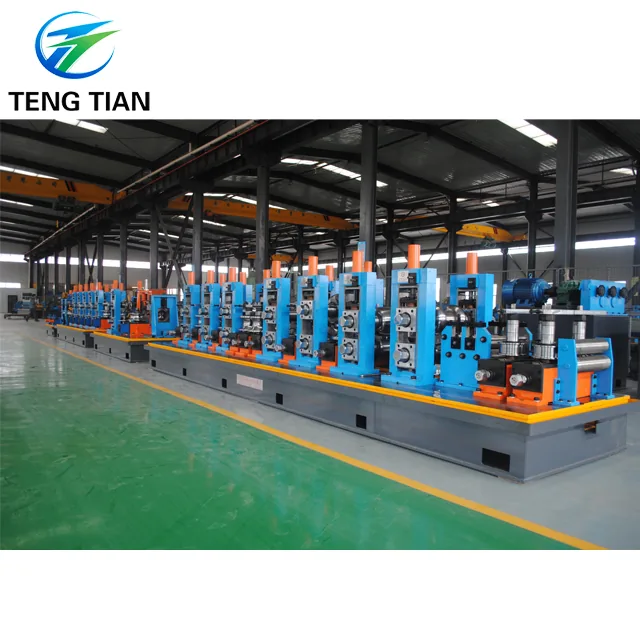
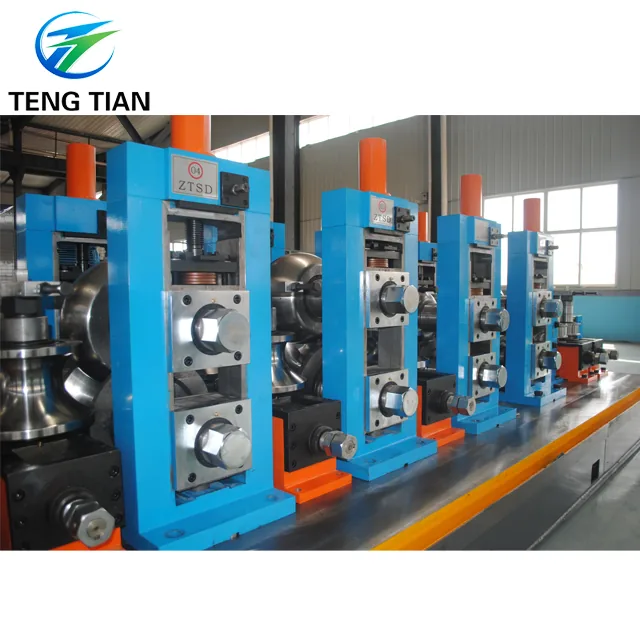
Tube mill for 114mm pipe
The line answers that in two places: the five-roller leveller flattens strip before forming, and the shear-welder plus spiral accumulator keep feed continuous so the forming section is not repeatedly started and stopped. The strip preparation in front of this mill matters more here than on the smaller steps, because a wider strip carries more of its own residual curvature into the forming section.
Wear Parts and Consumables
Saw blades by cutting volume; impeders and coils by welding hours; forming and sizing rolls on wear, machined on our own CNC equipment so replacements stay available. Cooling medium and hydraulic oil: specification from us, sourcing local.
Size Change, Roll Wear and Running Cost
Within Φ45–114 mm a size change is a roll-set change, and the cost of that change is time on the mill plus wear on the set. Roll material and heat treatment decide the second part.
Weld quality is on the equipment side through power matching, seam alignment and squeeze; strip quality and operation are on the buyer’s. Yield above 93 per cent is supported by the design and also depends on how the line is run.
Send diameter, wall and output and we will size the step and say what is still open.
Where this step sits in the twelve
HG114 is the fifth rung and the last of the small-diameter group. Above it the bands widen sharply: HG165 covers Φ60–165 mm, HG219 covers Φ114–219 mm. Note that HG219’s lower bound is this step’s upper bound, so the two meet exactly rather than overlap.
Anonymised delivery record
Deliveries in this band: Egypt at HG76 × 3 and HG89 × 5, Sri Lanka at 89 × 5, India at 76 × 3, Mexico at HG114 × 4, and Malaysia at HG60 × 3.
The buyer for this band
Two end-user profiles meet at this diameter. The regional pipe maker, judging on payback, changeover and running cost; and the auto-parts or new-energy manufacturer, judging on dimensional accuracy and stability with technical response time as part of the decision.
For the second profile the relevant capability is control rather than mechanics: PLC industrial-computer control with variable-frequency and servo adjustment, giving stable repeatable operation.
Delivery, installation and support
Shipped dismantled in containers, delivery 50 to 90 days, installation and commissioning included with on-site dispatch and round-the-clock online support, single contact replying within one hour. Payment 30 per cent deposit, 70 per cent before shipment, third-party escrow available.
The process principles behind this band
Roll forming bends the strip progressively into an open blank, with pass count, roll gap and roll profile deciding shape accuracy and seam alignment. Skin and proximity effects concentrate the high-frequency current at the open edges, heating that line to welding temperature; frequency, power and welding speed decide whether the heating stays concentrated.
Squeeze rolls then press the heated edges together into a continuous seam — a pressure weld, with squeeze amount, temperature and alignment deciding fusion quality and pressure rating. Cooling, sizing and straightening finish the dimension and straightness.
Operating steps that need training
Loading and threading, shear-weld coil joining, specification setting and tooling change, and weld parameter setting are all as requiring training; cutting and collecting is routine.
What to send with an enquiry
Outside diameter, wall, section shape and target output, plus whether you need in-line inspection — because that answer decides between this line and the API configuration.
One more boundary on this step
Incoming strip is the buyer’s responsibility: the line offers levelling and incoming inspection capability, while grade and flatness of the strip itself stay on the buyer’s side. That division is worth reading before commissioning, because a shape problem traced to incoming material is not a machine fault and is not resolved by adjusting the mill.
Two divisions worth repeating here
Weld fusion sits on the equipment side through power matching, seam alignment and squeeze control; strip quality and operating practice sit with the buyer. Dimensional accuracy divides the same way: sizing and straightening on the equipment side, incoming strip thickness tolerance on the buyer’s.
Material yield is shared: the line design supports a yield above 93 per cent, while the yield achieved also depends on scheduling and operating practice.
What changes as the band moves up
Between HG89 below and HG165 above, this step is where two things start to shift.
Strip width goes up, so residual curvature carried into forming matters more, and the levelling stage ahead of the mill does more work. Handling goes up, so the packing pattern begins to move from fully cased toward braced bare frames — a change that apply to large-diameter and heavy lines rather than against a specific model number.
Consistency after the change is a control question rather than a mechanical one: servo positioning limits drift, and PLC with variable-frequency control keeps line speed and cut length repeatable.
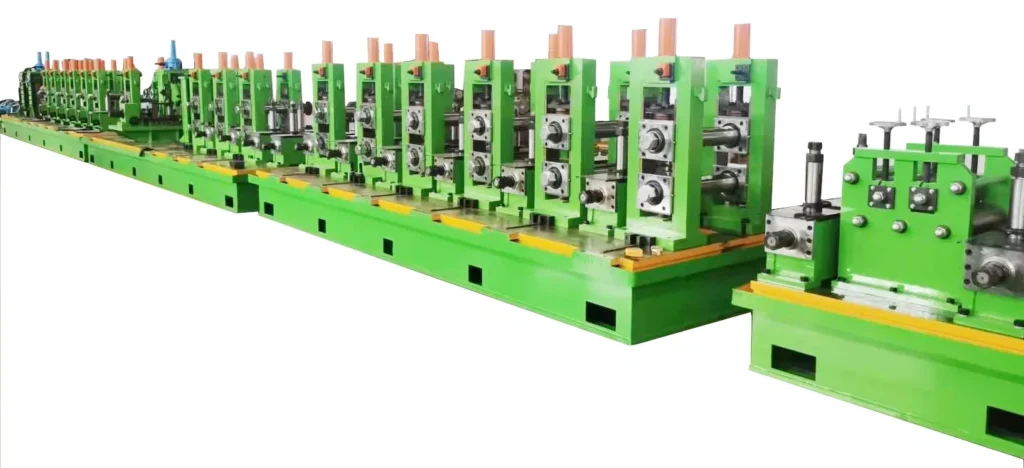
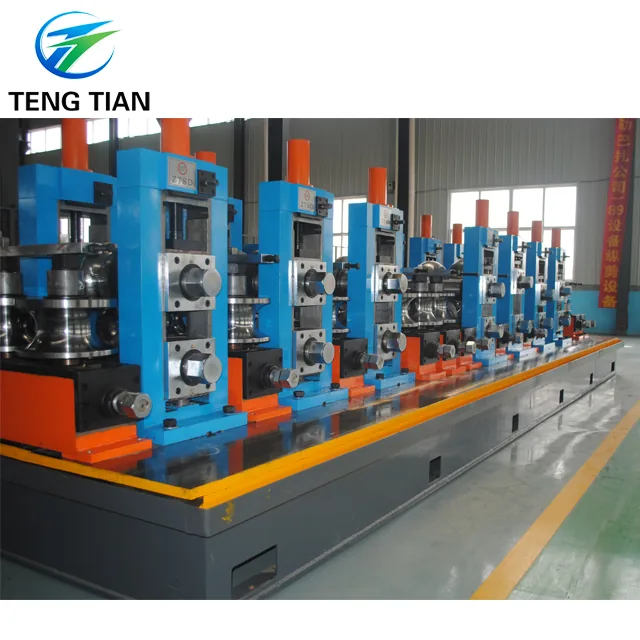
Line Photos from the Works
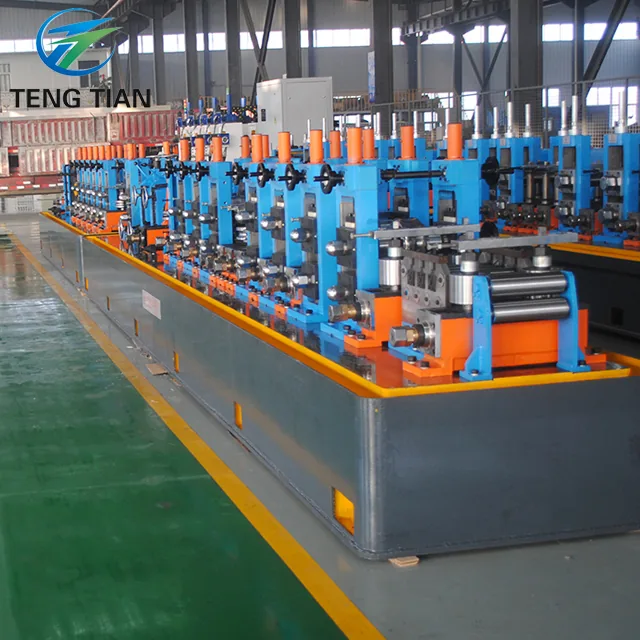
Four photographs of this line, taken in our own workshop. Click any photo for the full-size image.
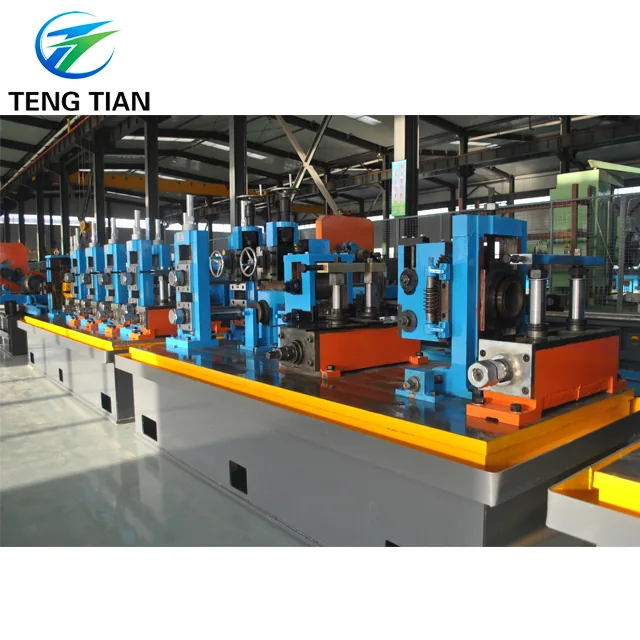

More from this line
 HG76
HG76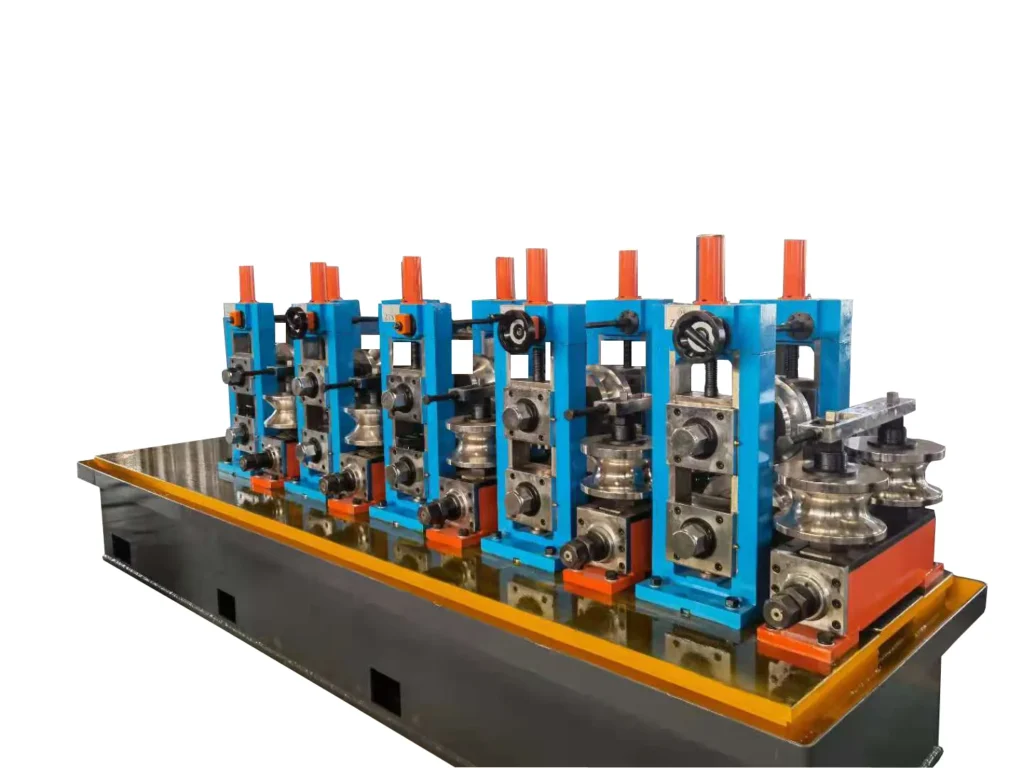 HG89
HG89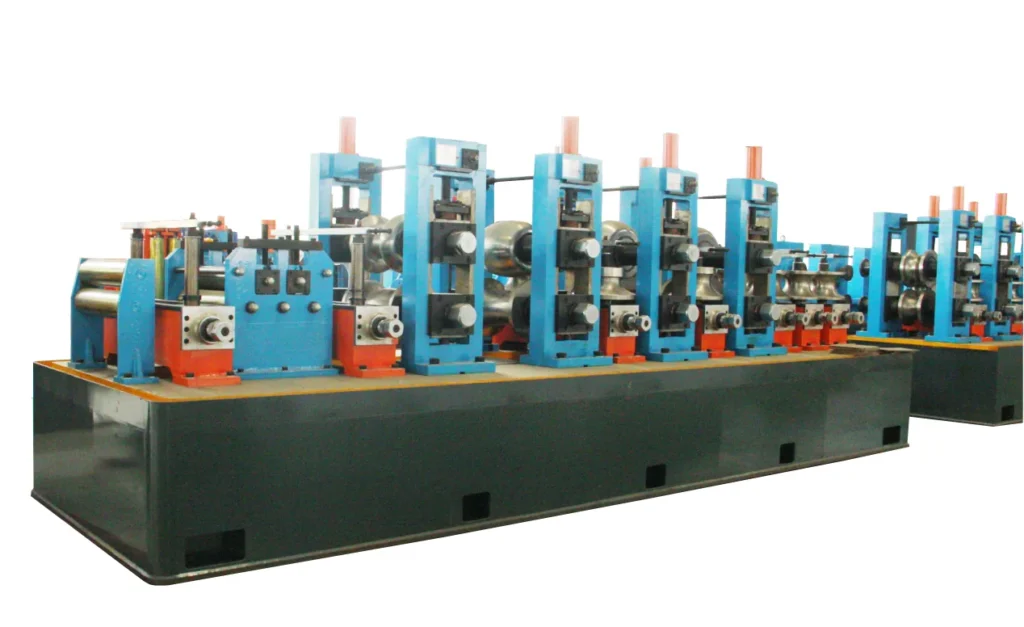 HG165
HG165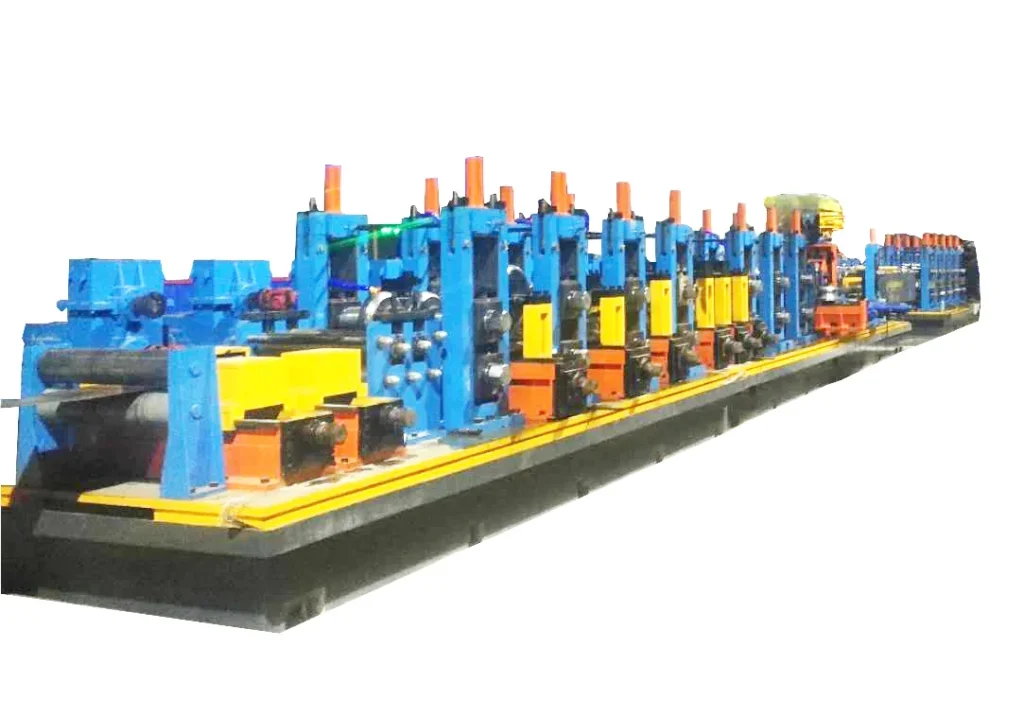 HG219
HG219Send Your Enquiry
Tell us the pipe outside-diameter range, the wall thickness and the output you need. An engineer reads every enquiry — it does not land in a general sales inbox.