
 Scan on WeChat
Choosing a Tube Mill by Pipe Diameter
More Articles
Quick Contact
Hebei TengtianYuanle@tentubemill.com
+86-311-83025332
WhatsApp +852 5425 3155
Published 14 September 2026
Diameter is the first decision, not the last
Those numbers matter, but they cannot be answered until the diameter range is fixed.
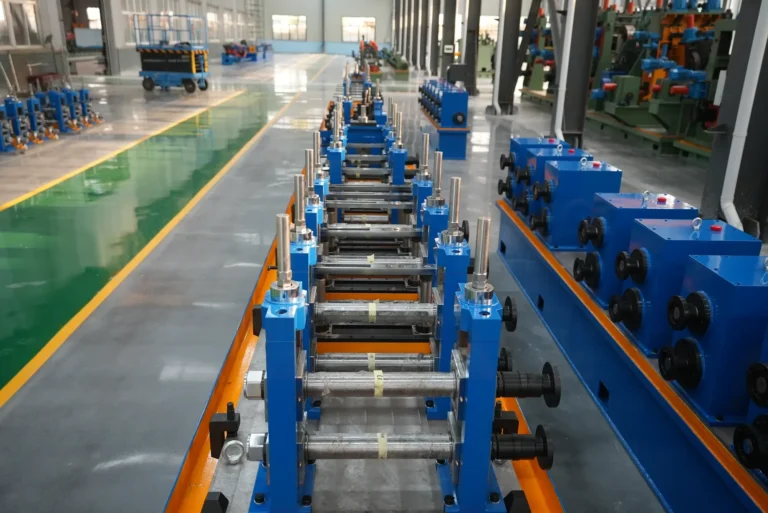
Diameter sets the forming stand size, the roll set, the shaft diameter and the mill frame. A line built for 32 mm pipe cannot be persuaded to make 200 mm pipe by running it slower.
So the first question is narrow: what is the smallest and the largest outside diameter you need to produce on one line?
Two groups, twelve steps
Our tube mills fall into two groups by diameter — small diameter and large diameter — and each group is divided into steps. Each step is a separate mill size with its own frame and roll set.
| Model step | Outside diameter | Group |
|---|---|---|
| HG32 | 10 – 32 mm | Small diameter |
| HG50 | 16 – 50.8 mm | Small diameter |
| HG76 | 12.7 – 76 mm | Small diameter |
| HG89 | 32 – 89 mm | Small diameter |
| HG114 | 45 – 114 mm | Small diameter |
| HG165 | 60 – 165 mm | Large diameter |
| HG219 | 114 – 219 mm | Large diameter |
| HG273 | 114 – 273 mm | Large diameter |
| HG325 | 165 – 325 mm | Large diameter |
| HG426 | 165 – 426 mm | Large diameter |
| HG508 | 219 – 508 mm | Large diameter |
| HG630 | 325 – 630 mm | Large diameter |
The ranges overlap on purpose
Look at HG50 (16–50.8 mm) and HG76 (12.7–76 mm). A 45 mm pipe sits inside both. That is not an error in the table. It reflects a real choice.
The smaller mill will hold tighter tolerance at the bottom of its range and change over faster between nearby sizes. The larger mill gives you headroom: if your product mix is likely to move upward in two years, buying the next step up costs less than buying a second line later.
A simple way to decide: list every size you make today, then every size you expect to add. If all of them fit inside one step, take the smaller mill. If the expected sizes push past the top of that step, take the next one.
What diameter alone does not settle
Two more variables sit alongside diameter and can move you between steps.
- Wall thickness. The same outside diameter in a heavier wall needs more forming force and a sturdier stand. A mill that comfortably makes 114 mm thin wall may be at its limit on 114 mm heavy wall.
- Material. Carbon steel, galvanised steel and stainless behave differently in the forming section and at the weld. Tell us the grade, not just the thickness.
- Section shape. If you also need square or rectangular tube from the same line, the sizing section changes. Square tube can be produced by reducing a round tube, or formed directly — two different line layouts.
What to send us
You do not need a full specification to start. Three lines are enough.
- Outside diameter range: smallest and largest
- Wall thickness range
- Material and grade
With those three, we can tell you which step fits, whether one line covers your whole range, and what the roll change between your sizes actually involves.
From the Workshop
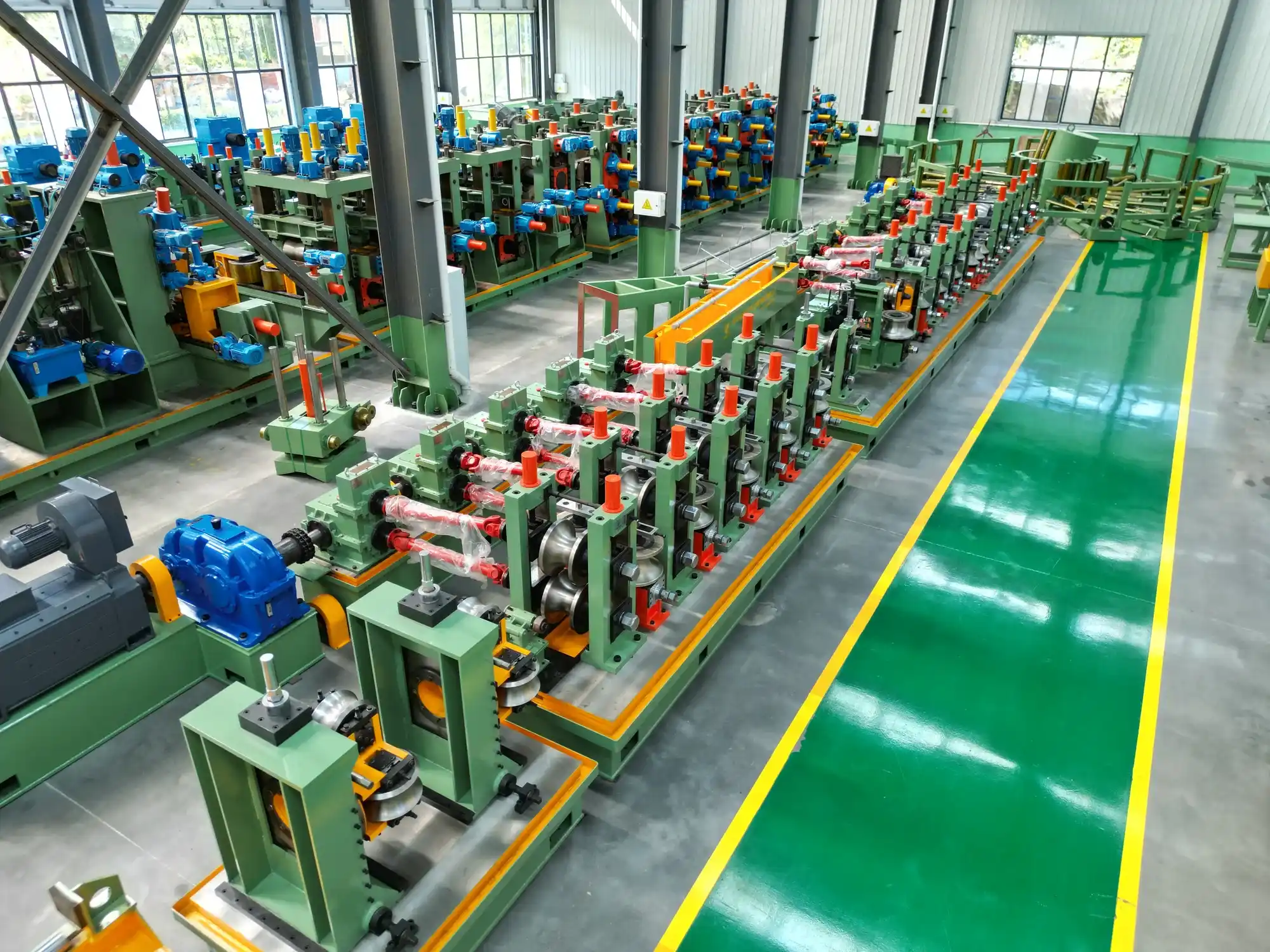
Send Your Enquiry
Tell us the pipe outside-diameter range, the wall thickness and the output you need. An engineer reads every enquiry — it does not land in a general sales inbox.